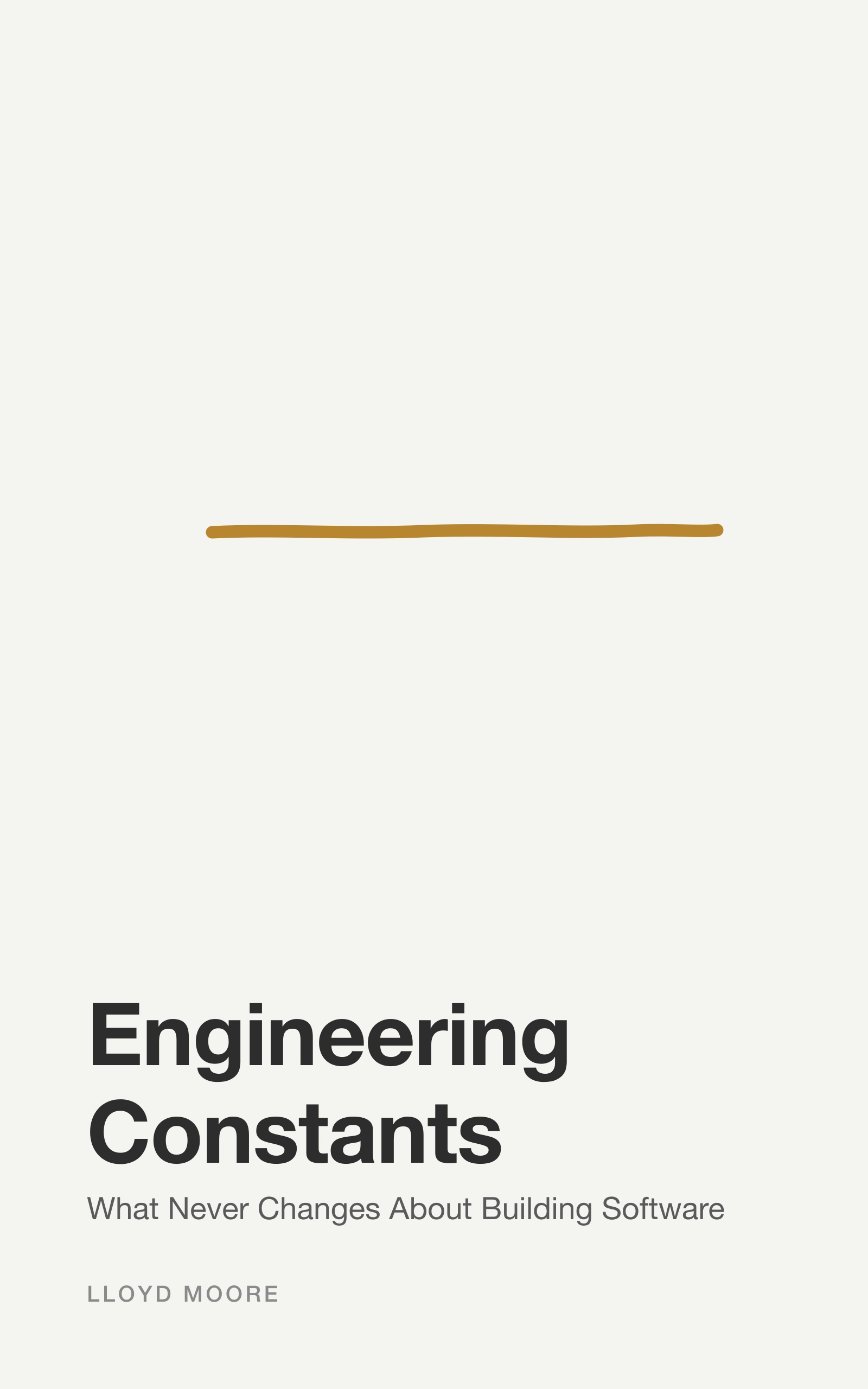
Engineering Constants
What Never Changes About Building Software
AI changes how software gets built. It does not change what makes building software hard. Seven structural constants — coordination, context, interfaces, measurement, accountability, decisions — that were true in 1970, are true now, and will be true in 2035, whatever the tools become.
Get the Book
Digital Edition
The complete book as a DRM-free PDF — read it anywhere, keep it forever. The Seven Constants reference card is included at the back.
- DRM-free PDF, 225 pages
- The Seven Constants reference card
- Instant download, 7-day re-access
- Future updates included
Kindle, Paperback & Hardcover
Three formats on Amazon. Kindle ebook, 6×9 paperback, and hardcover.
- Kindle ebook — $9.99
- Paperback — $19.99
- Hardcover — $29.99
Not ready to buy? Read the essay series free — one essay per chapter — or get the next one by email.
The Numbers in the Book
What's Inside
Agile, microservices, cloud: three revolutions that changed everything except the problems. The four-part test for what counts as a constant, and what would prove this book wrong.
Klarna's eighteen-month reversal, Duolingo's walk-back, the outsourcing parallel. Why capability gains have never translated into headcount reduction, and who pays when organisations try.
The system mirrors the communication structure — validated across 142 studies, never wrong in sixty years. AI agents are nodes in the graph, and the architecture will follow.
Writing code was never the hard part. Tacit knowledge resists documentation, transfers only through shared experience, and is permanently out of reach for any system that cannot participate.
Brooks's channels, Amdahl's ceiling, the Universal Scalability Law's retrograde peak. The mathematics of why 10× individual capability produces 3.57× organisational throughput.
DORA was the best metric ever built, and Goodhart's Law is defeating it anyway. Why every metric corrodes when it becomes a target, and what judgment can do that dashboards cannot.
Hyrum's Law, Postel's reversal, the four-hour diagnosis of a twelve-minute fix. Every AI agent is a new boundary with implicit contracts nobody negotiated.
Darley and Latané's bystander experiments, Boeing's 737 MAX, the hollow review. The courts, the regulators, and the 3am page all require a named human.
Ariane 5's $370 million lesson in the asymmetry between executing a decision and getting it wrong. The synthesis: the seven constants as the hidden costs every decision carries.
The Companion Volume
Engineering Economics counts the costs. Engineering Constants names the laws. One audits; the other derives. Read together, they are a single account of the hidden structure behind engineering decisions.
Engineering Economics: The Hidden Costs of Technical Decisions is available now — read more and get the calculators, or view on Amazon.